Veyrath Republic - capital and council architecture
The capital: Thalor-talen
Basic idea
The capital of the Republic is Thalor-talen, literally the Council City.
The name is deliberately functional and has an old-fashioned republican feel. It is precisely this apparent generality that makes it strong: the capital is not named after a founder, a dynasty or a myth, but rather after the form of its political order.
Location
Thalor-talen lies in the lower reaches of a wide Norel, just before the river opens into a coastal basin. In this way the city connects:
- River trade
- Coastal access
- Bridge and transit control
- dense internal supply
- later orbital and long-distance transport connections
The capital therefore appears less like a closed residential city and more like a knot of water town, archive center, market landscape and transport hub.
City structure
Thalor-talen is built polycentrally. The Republic avoids a purely palace center, preferring instead several strongly legible district cores connected by bridges, waterfront terraces and broad vethor axes.
The classic city sketch consists of a central council core and five large functional belts.
| Area | Character | Main function |
|---|---|---|
Thalor-karen | open political center | Place of large gatherings, rallies and republican rituals |
Vethan-orven | dense legal and archive district | Law, registers, documentation, media archives, trial houses |
Kethar-rimen | loud production and market belt | Crafts, associations, market halls, supply logistics |
Vel-lonath | orderly living and educational space | Schools, institutes, apartments, educational institutions, civil service districts |
Moran-verun | Long-distance transport and diplomacy zone | Spaceport, long-distance ports, legations, transit control |
Between these zones lie rows of bridges, water courtyards and public forecourts. This means that the city is not readable in a radial-monumental manner, but in a network-like manner.
Cityscape
The following are typical for Thalor-talen:
- wide stone and silor facades with clear geometry
- open courtyards instead of completely closed administrative blocks
- Watercourses and basins as part of the city architecture
- many bridges, footbridges and forum terraces
- mixed neighborhoods instead of hard separation of politics, housing and education
Republican power is not behind walls here, but in buildings that are visibly frequented. This is precisely why access, protocol, guard regulations and public paths are regulated very precisely.
Social peculiarity of the capital
Thalor-talen is not just a government town. She is at the same time:
- largest media center in the republic
- the most important training location for administrative and council culture
- important archive and research center
- symbolic space for republican self-dramatization
Many children's homes, educational centers and specialist institutes in the capital are considered to be particularly influential for later political careers. This means that republican openness is real, but never remains completely free of networks of origin.
The central council building: Torim-kovath
Function
The most important political building in the republic is the Torim-kovath, the Open House.
The Isyr-thalor meets here. The building is not a palace or a pure chamber hall, but a combination of council building, forum, committee complex and public protocol room.
Why it's called that
torim means open. The name is programmatic:
- Decisions should be visible.
- Access routes should be regulated, but not mystified.
- Architecturally, the state should not exude a monarchical distance.
Architectural designThe Torim-kovath is designed as a large, terraced pentagon building. Its shape is reminiscent of a ring, a star and a stretched square. The core is not an elevated throne hall, but a sunken debate room to which all paths lead.
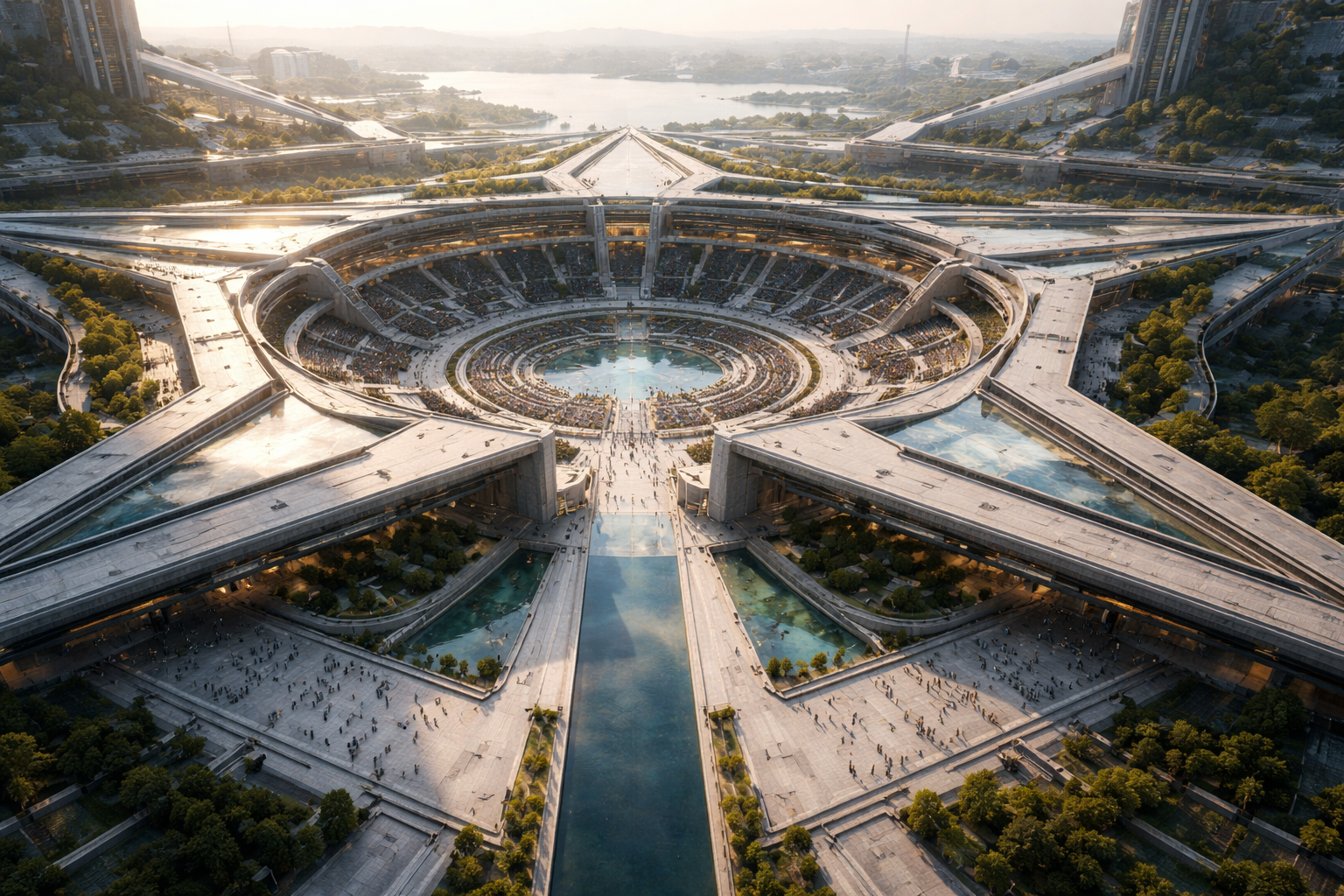
Characteristic features are:
- five large entrances from different city axes
- a central, low-lying meeting chamber without a permanent ruler's seat
- Circumferential public galleries for observers, media and delegations
- Lateral reject rings for skilled work
- direct bridge connection to the
Vethan-orven - Water channel from the
Norel, which crosses the forecourt and merges into a shallow mirrored basin in the interior
Symbolism
The symbolism of the building is strongly republican and consciously anti-monarchical.
| Element | Symbolic reading |
|---|---|
| five input axes | all five genders and all major functional areas belong in the state, but none of them owns the center alone |
| sunken main hall | political speech rises from the common space and does not sit above it |
| missing throne or permanent presidential seat | no individual embodies the state for himself |
| Watercourse through the forecourt | Decisions should flow, remain legible and be passed on |
| open galleries | Domination is observable and must withstand counter-speech |
Individual mottos of the republican order are written above the five main entrances:
veltorimtherinjorinravin
So: Clarity, openness, justice, togetherness and commitment to help.
Interior order
Inside, the Torim-kovath is divided into three layers:
- Lower ring: Archives, protocol rooms, technical control centers, security control.
- Middle ring: Committees, mediation rooms, specialist courts, delegation rooms.
- Upper Ring: Galleries, media balconies, visitor walkways and public observation areas.
The actual main hall lies in between like a political depression. Whoever speaks there is visible from all sides. This is exactly what the republican situation is supposed to create: Speech as an action under observation, not as a lofty announcement from above.